Bayesian models for marketing, customer and forecasting decisions. Every result is checked by five verification layers and approved by a person before anyone acts on it.
Four engine classes — forecasting, causal experimentation, marketing measurement, and customer economics — across all 12 decision packs today, run on demand or on a schedule you set.
New packs slot into these engine classes and run through the same verification stack. How verification works →
This is the loop TriaCaf is built around: watch the numbers you care about, re-check the models when something moves, and bring a verified recommendation to a person. The aim is for all three steps to run on their own; that is what we mean by always-on. It is rolling out in stages, so each step below says what it will do and what runs today.
Run any of 12 Bayesian packs on demand or on a schedule; every result verified and human-approved.
Keep an eye on the metrics you choose as new data arrives, and notice when one moves outside the range its model expects.
Today: anomaly checks on your latest upload, run on a schedule you set.
When something moves, re-run the packs that explain it on the new data, through the same five verification layers as any other run.
Today: you start a re-run on demand, or put it on a schedule.
Turn a verified result into a recommendation with its confidence attached, for a person to approve or send back.
Today: every run pauses for a person to approve it, and approved runs produce a signed Decision Brief.
What it's built with
Bayesian models across 12 decision packs, with the checking built in: every run is fit more than one way, verified layer by layer, and approved by a person before anyone acts on it.
Also: customer economics, forecasting, causal inference and A/B testing. All 12 packs →
You upload a CSV export.
Columns typed; gaps and outliers flagged before any fit.
Two or three model specifications, each fit on its own.
Execution, diagnostics, predictive check, sensitivity.
The fifth layer: a person approves or rejects the result.
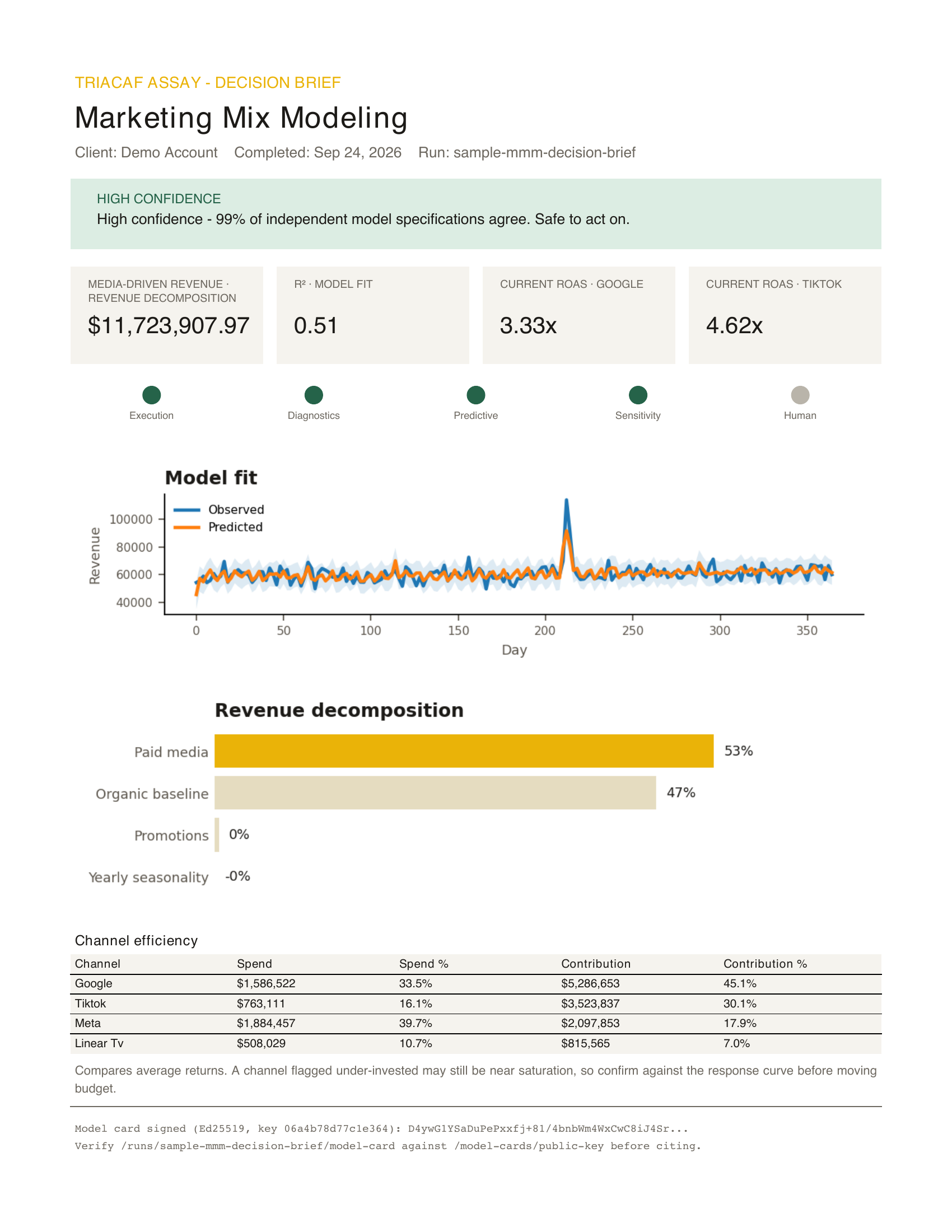
PDF or slide, carrying the run's Ed25519-signed model card.
Upload a CSV and TriaCaf profiles it, fits two or three model specifications, checks them layer by layer, and waits for a person to approve before producing a signed Decision Brief.
Bayesian models that forecast demand, estimate customer value and churn risk, model price response, and flag anomalies, each reporting full posterior uncertainty rather than a single point estimate.
Every result arrives with its verification status, a confidence verdict based on how closely the model specifications agree, and the full posterior uncertainty, then waits for a person to approve or reject it. Nothing acts on a result automatically.
Marketing Mix Modeling, Multi-Touch Attribution, Synthetic Control and Geo Test design: four packs for channel-level measurement, each reporting how uncertain its answer is.
Four questions teams bring to TriaCaf most often, and the decision packs that answer them. Each links to the live use case on the Solutions page.
Estimate the long-term value of each customer cohort, with credible intervals, so acquisition spend can be judged on long-run value rather than first-order conversions.
Hierarchical forecasting paired with anomaly checks that run on a schedule you set, so a real shift in demand, spend or usage is flagged without waiting for someone to open a dashboard.
Quasi-experimental lift estimation and Bayesian A/B testing for the decisions that can't run a clean randomized trial — with a real counterfactual, not a correlation.
Bayesian MMM quantifies the incremental revenue driven by every channel, giving finance and marketing a shared, auditable basis for reallocating budget.
Most analytics reports what happened. TriaCaf estimates what drove it, says how sure it is, and has a person sign off before anyone acts.
Data is downloaded weekly into disconnected Excel files, causing reporting delays and human error.
Upload your exports once; every dataset is profiled and validated before a model ever sees it.
Someone has to remember to open the dashboard. Nothing is actually watching for a real shift as it happens.
Hierarchical forecasts and residual-based anomaly checks run on a schedule you set, so a real deviation is flagged without anyone having to remember to look.
Looking backwards at what happened last month to guess at what should happen next month.
Bayesian models estimate lifetime value, churn risk and demand with credible intervals, re-run on demand or on a schedule you set as new data comes in.
A metric moved after the change shipped, so the change gets the credit — no counterfactual, no rigor.
Quasi-experimental and Bayesian methods estimate what would have happened anyway, so credit only goes where it's actually earned — reviewed by your team before anything moves.
How a new team gets started, and the checks every result passes before it reaches the people who act on it.
We start from the decision you need to make, pick the decision packs that answer it, and agree what data each one needs.
Mapping your exports into clean, profiled datasets — the dates, channels, outcomes and covariates each decision pack needs — validated before anything is fit.
Running the decision packs that fit the question — Bayesian models fit across multiple specifications, each result checked for convergence, fit, and cross-spec agreement.
A person on your team approves or rejects every result. Approved runs produce a Decision Brief with a signed model card, and you can schedule re-runs to refresh the answer as you upload new data.
How TriaCaf checks a result before anyone acts on it, and how to read what it hands you.
What each of TriaCaf's five verification layers checks on every run, and why the last one is a person.
The verdict banner, metric tiles, verification strip, caveat and signed model card, section by section.
Adstock, saturation, three specifications and ROAS ranges: how the marketing mix modeling pack works.
Open-source Bayesian tooling you can audit, running on managed cloud compute. Data comes in as CSV today; Google Ads and Meta connectors are in development.
Are your decisions based on lagging indicators or on models you can check? Six questions place you on the same four-rung ladder we use to describe the platform: reporting, monitoring, modeling, and verified decisions.
Your answers stay in your browser. Nothing is sent.