Every result on this platform climbs the same four rungs. Many tools stop at the third. The fourth — verification, in the open — is the reason a number here is something you can act on, not just something a model produced.
What happened. Dashboards and BI — a rearview mirror on last week's numbers.
Something changed. Alerting and anomaly flags — faster than reporting, still reactive.
Here's an estimate. Many tools stop here: a number, with no measure of how far to trust it.
Here's an estimate, here's how much to trust it, and here's the signed record proving how we got there.
Every run — all 12 decision packs — goes through the same five layers before a result is shown as final, and each layer's verdict is recorded on the run: passed, warning, failed, or skipped with the reason. This is the actual sequence, not a marketing simplification of it.
Did the fit actually complete without error, against the dataset it claims to have used. The floor every other layer builds on.
Every MCMC posterior is held to R-hat ≤ 1.01, a minimum effective sample size (ESS), and a divergence budget — the standard convergence checks. A result that misses them carries a visible "not converged" warning into the brief and model card; a fit that fails outright reports no number at all. Packs whose posterior is exact (closed-form) say so, rather than reporting a convergence score that was never measured.
Does the fitted model hold up against the data it was fit on? MMM runs a posterior predictive check; synthetic control must reproduce the treated unit before the intervention or the run fails; the other packs check that their predicted quantities hold up across specifications. Where a pack has no predictive check yet, the layer says "skipped" and why — it never shows a pass it didn't earn.
Every pack fits 2–3 independent model specifications in parallel — different priors, different structural assumptions — and reports an agreement score: how closely the specifications' estimates match each other. High agreement means the finding survives reasonable modeling choices, not just one analyst's setup. Low agreement is reported as low agreement, not smoothed into a single confident-looking number.
Nothing acts on a result automatically. A person reviews the model's confidence — posteriors, agreement score, flagged specs — and explicitly approves or sends it back. This is the layer that keeps a recommendation a recommendation.
On completion, every run is exported as a model card: what was fit, on what data, how it was validated, what it cost, and — explicitly — where it should not be trusted.
Every card is signed with an Ed25519 key, and the public key is published. Anyone holding an archived card — an auditor, a client, a regulator — can verify offline that it was issued by TriaCaf and hasn't been edited since, without having to take our word for it.
Every completed run generates a brief in two parts: the headline number, the chart that explains it, the verification stack's verdict, and a plain-language recommendation — then an analyst appendix with every model specification that was fit, their posteriors side by side, and why they agreed or didn't. Signed and traceable back to the run.
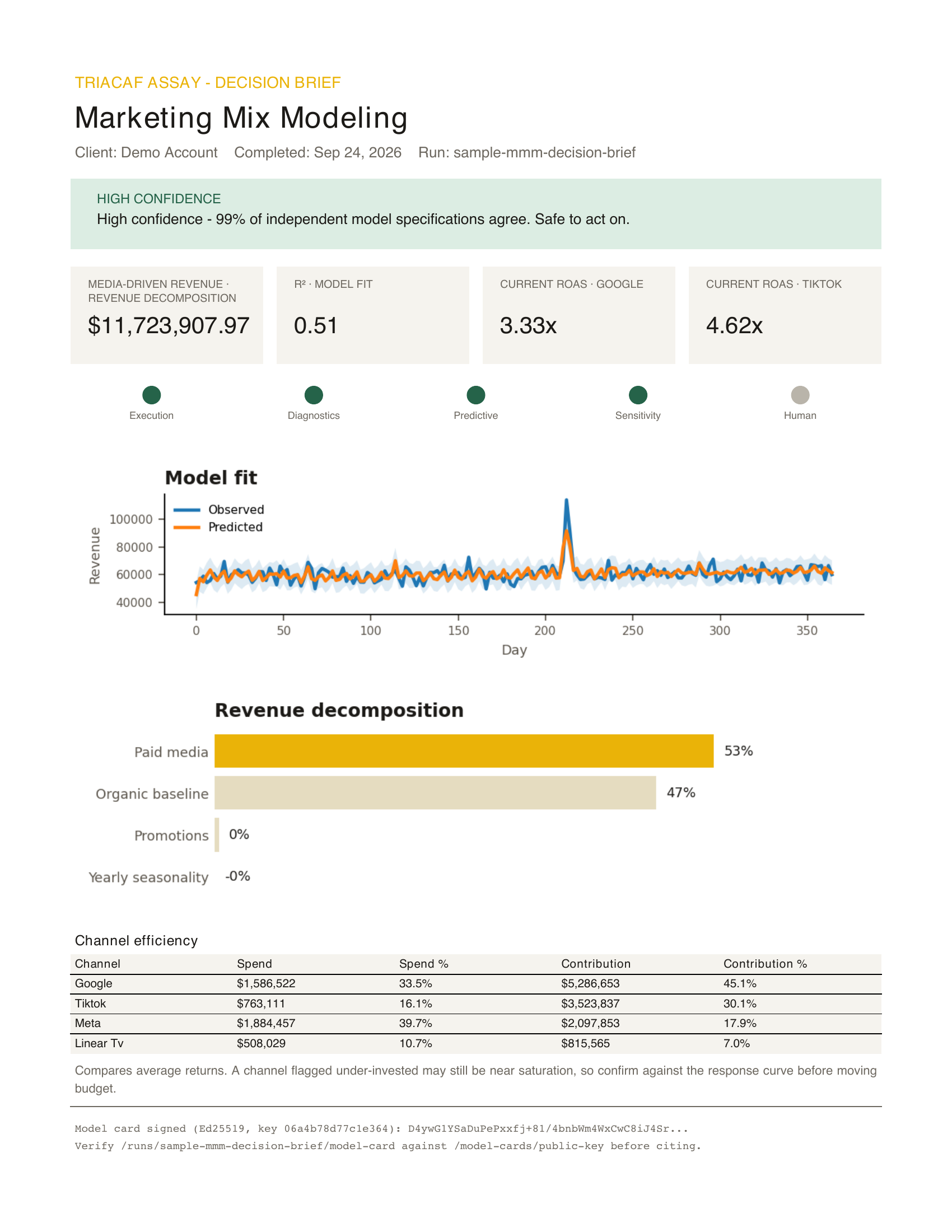
This is a real, unedited PDF produced by our Decision Brief renderer — the same code path that generates one for every completed run in the product. The numbers are representative demo data, not a real client's; the layout, the verification badges, and the charts are exactly what a client sees. The preview above is the first page; open the PDF for the analyst appendix.
Download the sample brief (PDF)Marketing measurement, customer economics, forecasting, and causal inference — every one verified the same way.